
- If It Ain’t Woke, Don’t Fix It: The Revanchism of Bad Object (Anti)-Fans
- When Puppies Start to Hate: The Revanchist Nostalgia of the Hugo Awards’ PuppyGate Controversy
- These Visual Delights Have Sonic Ends: Affective Attunement and Audiovisual Prolepsis in Westworld’s Title Sequence
- According to the Narrator, It Was a Dark and Stormy Night: Styles of Narration-as-Advocation in True-Crime Documentary Series
- I’m Gonna Wreck It, Again: The False Dichotomy of ‘Healthy’ and ‘Toxic’ Masculinity in Ralph Breaks the Internet
- Streaming’s Skip Intro Function as a Contradictory Refuge for Television Title Sequences
- POP! Goes My Heart: The Sound of Specific and General Love in Romantic Comedies and Dramas
- Throw in the Tune: Musical Characterizations of Disability in Wrestling Films
If It Ain’t Woke, Don’t Fix It: The Revanchism of Bad Object (Anti)-Fans
Javnost – The Public 32, no. 3 (2025): 394-408
This article contributes to the understanding of fan dynamics and far-right politics by offering a theoretical framework to explain the transformation of fans into anti-fans/reactionaries. Through analysing the fan backlash against True Detective: Night Country and Rick and Morty after the original male creators were “replaced,” this article demonstrates how interaction with a bad object triggers fans to embrace revanchist nostalgia. These fans-turned-anti-fans seek to punish those involved in the supposed destruction of their beloved series while attempting to rebuild what it was before. By considering how these fans argue the series are only worthy of their fandom if they are written and produced by men, this article theorises that far-right fan activity illustrates how revanchist nostalgia unites anti-fans and transforms once-loyal viewers into vicious defenders of an imagined past if a series embraces diverse perspectives and/or distances themselves from their previous hypermasculine norms. This article underscores the ways in which (anti-)fan culture, audiovisual media consumption, and far-right ideologies intersect, revealing how reactionary fan responses are not merely focused on the content of the media but are rooted in maintaining ideological dominance and resisting progressive change.
When Puppies Start to Hate: The Revanchist Nostalgia of the Hugo Awards’ PuppyGate Controversy
Communication and Critical/Cultural Studies 20, no. 4 (2023): 453-70
In 2015, two groups of right-wing authors and fans – the Sad and Rabid Puppies – flooded the Hugo Awards with literature they deemed “popular” and anti-“message fiction.” These reactionaries mobilized the affects of melancholy, anger, and hatred against the increasing diversification of speculative fiction. Through analyzing the affective economy of “PuppyGate,” this article demonstrates the key role of nostalgia in the affective economies of reactionary movements, paying particular attention to the tension between restorative nostalgia, with its aim to return to an imagined past, and revanchist nostalgia, which strives to destroy the present and punish those who made that destruction necessary.
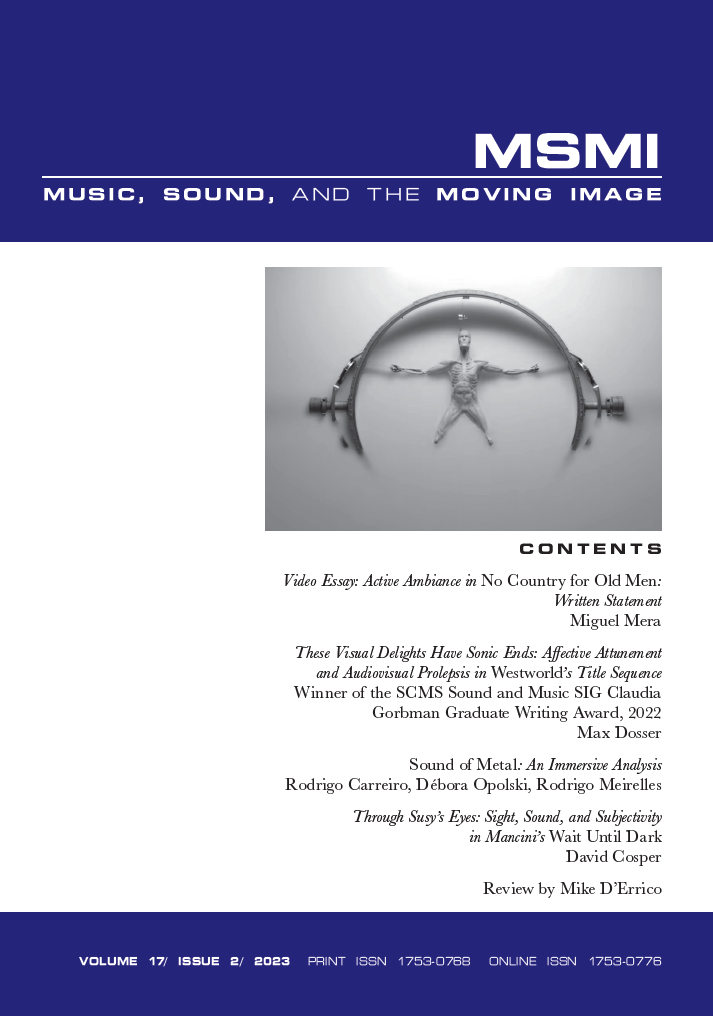
These Visual Delights Have Sonic Ends: Affective Attunement and Audiovisual Prolepsis in Westworld’s Title Sequence
Music, Sound, and the Moving Image 17, no. 2 (2023): 87-110
Through the blending of the science fiction and western genres, the HBO series Westworld explores issues of humanity and agency. These themes are not only played out through the series’ sprawling storylines; they are also encoded in the series’ title sequence. In this essay, I expand Leslie A. Hahner’s concept of affective prolepsis in visuals to audiovisual prolepsis in order to illustrate how the paratextual title sequence visually and musically prepares the audience by encoding the series’ central philosophical questions of what it means to be alive and the role of agency in the conception of humanity. I argue the title sequence attunes the audience to these questions through a visual assembly of a body and a musical foreshadowing of a dance of agency and power struggles. Through considering audiovisual prolepsis, scholars are better able to understand how the intentions of media creators translate—successfully or unsuccessfully—to viewer experience and interpretation.
According to the Narrator, It Was a Dark and Stormy Night: Styles of Narration-as-Advocation in True-Crime Documentary Series
Journal of Film and Video 75, no. 2 (2023): 45-62
On October 3, 2014, the world was introduced to the largely unknown story of Adnan Syed, a young man who had been convicted and jailed for over a decade for the murder of his ex-girlfriend. Through the podcast Serial (2014–present), Sarah Koenig, the journalist investigating the story, brought to light how the fourteen-year-old case might not have been as open-and-shut as it seemed. In Serial, Koenig, as the host/narrator, guided listeners through old and new evidence in the case of the no-longer-young Syed. Almost two years after the debut of Koenig’s groundbreaking podcast, on June 30, 2016, a judge granted Syed’s motion for post-conviction relief and ordered a new trial to be held. Serial, “the most popular podcast in the world,” put Syed’s case on the map and led to a new examination of the crime on the grounds of ineffectual counsel…
I’m Gonna Wreck It, Again: The False Dichotomy of ‘Healthy’ and ‘Toxic’ Masculinity in Ralph Breaks the Internet
Critical Studies in Media Communication 39, no. 4 (2022): 333-46
This article examines the representation of masculinity in the animated Disney film Ralph Breaks the Internet (2018). Popular reviews of the film focused heavily on critiques of toxic masculinity. Often associated with homophobic and misogynistic speech, the concept of toxic masculinity ultimately serves to reinforce and rescue elements of hegemonic masculinity by painting “toxic” male behaviors as something that can be “cured” or “fixed.” To probe the troubled concept of toxic masculinity as seen in animated media, this article demonstrates how Ralph Breaks the Internet reifies a false dichotomy of healthy and toxic masculinity. Through examining the ways Ralph’s physical appearance, his behaviors, his manipulative relationships with women, and the film’s ultimate resolution reflect the current crisis of masculinity, this article argues that while reviews claim the film critiques toxic masculinity, the film itself actually reinscribes qualities of hegemonic masculinity. By invoking toxic masculinity in scholarship and reviews, critics obscure other critiques of masculinity films may put forward—positive and negative.
Streaming’s Skip Intro Function as a Contradictory Refuge for Television Title Sequences
Velvet Light Trap 90 (Fall 2022): 38-50
This article argues that streaming television’s “skip intro” function, although designed to allow audiences to forego title sequences, has created a space for theme music and title sequences. In doing so, it preserves the cultural technology of theme music and furthers audience control in a time of changing viewing habits and increasing binge-watching. In the creation of this space, one sees how portals are embracing a hybrid model of linear and nonlinear television in order to create a feeling of agency that is increasingly key in practices of post-network television.
POP! Goes My Heart: The Sound of Specific and General Love in Romantic Comedies and Dramas
Music and the Moving Image 14, no. 3 (2021): 46-60
This article argues the original compositions in the romantic comedy Music and Lyrics (2007) and the romantic drama A Star is Born (2018) illustrate the differing depictions of love in the two films—one rooted in the specificity of the on-screen relationship and the other more general and rooted in the emotion of the relationship—which reflect a distinctive positioning within their respective genres.
Throw in the Tune: Musical Characterizations of Disability in Wrestling Films
Journal of American Culture 43, no. 4 (2020): 300-311
In 2019, two American-produced wrestling films premiered to high acclaim: The Peanut Butter Falcon and Fighting with My Family. Both films prominently feature characters with disabilities—Zak, in The Peanut Butter Falcon, has Down Syndrome, and Calum, in Fighting with My Family, is blind. Each film tackles the idea of what ability means in an American athletic context not only through their narratives, but also through their music. While disability studies scholars have written about the intersection of music and disability studies, their work largely elides film compilation scores. Drawing on musciological work on compilation scores, I interrogate how the music of each film represents disability and rejects the medical model of disability so often seen in the sports film genre. I apply Ron Rodman’s networked model of signification to the two films to illustrate how the films musically represent disability: creating then dissolving a musical dichotomy of (dis)abled bodies and creating musical uniformity across ability.
 Max Dosser